When Web Builders Update: Getting Nerdy With It

Technology is advancing and evolving every day. With the advent of AI, we’re seeing new tools emerge faster than ever. That also includes web builder platforms.  Sometimes, you build out your site with fancy add-ons, and then the builder updates, and you just hope your add-ons are still supported.

For example, the WordPress plugin Elementor, which we use for our Nerd Crossing website and some of our clients’ websites just launched version 4.0. Being the Nerds that we are, we checked it out. If your website isn’t currently hosted on WordPress, this post isn’t for you. If you are hosted on WordPress, and/or are interested in Elementor, keep reading!

Here’s what you need to know:

What’s New

Disclaimer: Elementor is a robust and versatile web builder and page builder that essentially allows you to create a fully custom website from scratch. While it has a lot of amazing functionality, it also has a learning curve and may not be right for everyone. With that said, Nerds love being nerdy, and this baby is right up our alley!

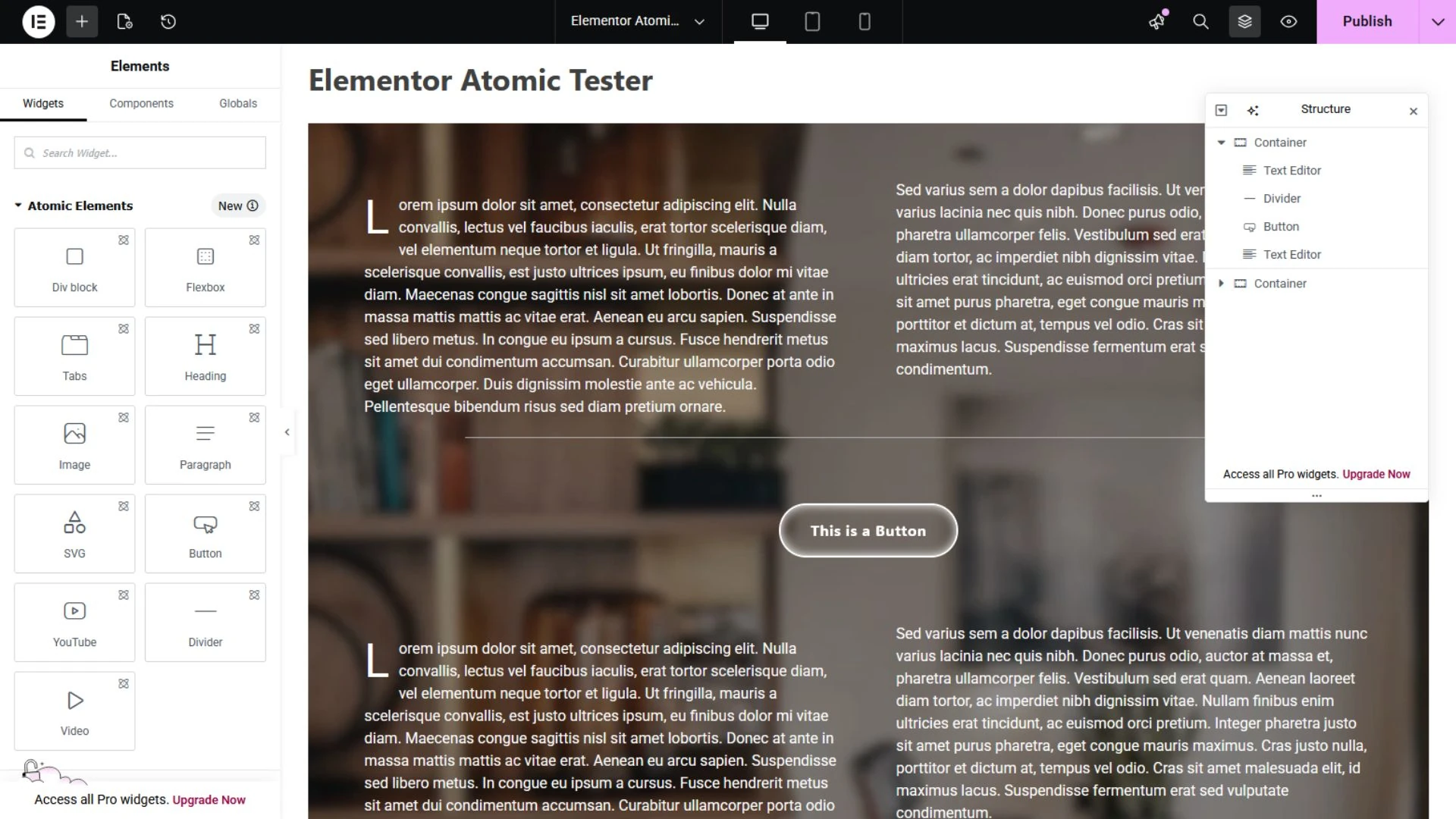
4.0, AKA “Atomic” is currently an optional version you can activate or deactivate in your Dashboard. The builder UI is still pretty much the same, but there are some new widgets and a new way to create styles, variables, and classes right in the page builder. This is a great feature which can streamline and simplify the styling of your entire website (as long as you know what you’re doing).

Pros

The new Atomic widgets are essentially blank building blocks which you can customize as much or as little as you like. How you customize them has also been streamlined, with settings grouped together in a more logical way that is uniform for each widget. No more clicking around to different tabs.

You can also now save elements as reusable components and make parts of them editable, which essentially means you can make your own custom widgets right there in the page editor. This is currently only available on the Pro version of Elementor, but creates a lot of potential flexibility for web designers.

Probably the best and most important part of this update is that it remains backwards compatible with older widgets and add-on plugins. Whatever you already built out on your website will still be functional and editable in this new version the same way as before. You can keep the widgets you already have on your site and continue to add them to pages going forward. 

Cons

As with all new technology releases, Elementor 4.0 has a few bugs that need to be worked out and some limitations we’re hoping will be addressed with future updates. There are only a few Atomic widgets currently available (with more to come). This may be offset for most users with the ability to create custom components, but you cannot create those with legacy widgets.

As this is a new update, some older add-on plugins that allow you to use Elementor templates, or combine or nest widgets don’t always recognize the new Atomic styling convention, which may cause issues. Until the plugins update for compatibility, you can avoid problems by substituting legacy widgets for Atomic ones.

The biggest limitation is the new Atomic Paragraph widget. Arguably the most essential piece of a webpage, it adds text one Atomic paragraph widget at a time. The Nerds rate it a 3/10. Less, if you’re working with large blocks of text, like a blog post. For this, we recommend using the legacy Text Editor widget, which still retains full functionality with more options for customizing your text in one instance.

While the Elementor web builder update made global styling easier in some ways, its most powerful functions may still be too complex for the average user, especially if you’re new to Elementor, or web design in general. Some knowledge of CSS is definitely required and recommended, even with more and more tutorials popping up on YouTube every day.

Conclusion

The new Elementor plugin does make creating style sheets easier as a user interface with variable controls that allows you to click through and preview changes to styling in real time, rather than typing out whole sequences of code and hoping you don’t miss an end bracket.  With that said, you are, in fact, creating modular code to style your website using this tool.

So who’s this for? Well, we probably wouldn’t recommend it as a starting point for beginners building their first website, but if you have a little experience under your belt and you like to kick the tires on new tech, this is a good one to try out. Also, if you’re handing off  a custom website to a client for future content edits, they might appreciate the WYSIWYG Elementor editor over the native WordPress Block editor, too. 

Need Some Help?

All of these new bells and whistles can be a lot to learn and absorb. But don’t worry, your friendly neighborhood Nerds are here to help you out! Does your website need an update, or an ADA compliance check? We can help! Give us a shout and we’ll get you sorted out.

Level Up Your Website with Multimedia Content (with Caveats)

Landing on a website full of text is the digital equivalent of reading a textbook for fun. If you want to engage your visitors to click around and absorb what you’re offering, give them something worth looking at.

Multimedia Content Boosts Engagement

A picture speaks a thousand words, they say. In today’s world of 3-second attention spans, the “elevator pitch” may be best delivered with a crisp photo. Multimedia content isn’t just about making your website pretty. These types of visual elements can communicate your message in a split second, long before a visitor reads a single sentence. Not only that, the richer experience will keep them on your site longer, which also increases the odds of them eventually reaching out. That’s incredibly powerful.

Infographics are another great tool to get your message across. Whether it’s illustrating a tricky process, or the impact you have on your local community, visitors will understand a clean visual faster and remember it longer. Visual content is also the backbone of social media. When your website content is rich with shareable visuals, your reach extends well beyond your homepage.


Now, The Caveat

Okay, so you’re sold on adding visuals. Great! But take a second to think about where your visuals will come from and how you will use them. This is where a lot of well-meaning business owners accidentally get into trouble: copyright infringement and privacy violations.

Copyright law applies to everything you find online. Every photo, video, illustration, and piece of music belongs to someone. Using it without permission can result in takedown notices, legal disputes, and massive fees, and “I found it on Google” is not a legal defense.

Likewise, using photos and videos of real people, including clients, friends, family, community members, or even event attendees without their permission is a violation of their privacy, and may pose a safety risk, especially when it involves minors. It also should go without saying that you should never upload anyone’s photo or video into generative AI.


How to Use Multimedia Safely

Use content you own
The safest thing to do is use photos you took yourself, or paid a professional to take for you. In both of these cases, you are the proper legal owner of the content. However, if those photos include other people, always make sure you get permission from them. A simple written release or permission form goes a long way.

Obtain properly licensed stock images and videos
Buy and download properly licensed content from reputable platforms. Search for royalty-free resources, which provide you with multimedia for free, or a nominal one-time fee that does not require you to pay usage royalties over time. Pexels, Adobe Stock, and Deposit Photos are all excellent places to start. Just make sure to always double-check the license terms before you purchase and publish.

A Special Note on AI

AI-generated content is a hotly debated topic currently being litigated on several fronts. While it is not illegal to use for now, it also cannot be copyrighted, meaning you can never own any multimedia you create with AI engines, or prevent others from using it however they choose. Just as importantly, public sentiment has been decidedly negative toward AI-generated content. Whenever possible, we recommend avoiding the use of this type of media for your website and marketing.


Level-Up Your Website

Multimedia content is one of the best investments you can make in your website experience. It grabs attention, tells your story, and keeps visitors engaged. If you want to spruce up your existing website, or build one from scratch to present your organization to the world at large, we’re here for you. Give us a call, or drop us a line, and let’s chat about how we can help your website make a real statement online.

Domain Names: How Not to Lose Them

Picture this: You get an email notification about your domain name expiring. You mark it as Read and move on with your day. Two months later, your friend asks you what happened to your website—it’s not working anymore.

Turns out, you never acted on that notification. Your website domain name registration expired, and someone else bought it. You just lost your website, your branded email, and access to all accounts that you set up with it.

Now what?

You don’t own a domain. You rent it.

When you purchase a custom URL, you don’t own it indefinitely. You rent it for a set period of time. If you want to keep it, it’s up to you to renew it when the term expires. If you forget, you could find yourself in a world of trouble. Expired domains go to auction and can be bought by anyone. And once they have your branded URL, they could hijack your brand to spoof your business, or even hold the domain name for ransom, forcing you to pay whatever they ask to get it back.

This is not a scare tactic or an urban legend. It’s a real-world issue that happens every day, and affects thousands of people and small businesses, costing not just money, but SEO power and brand reputation, too.

How to protect yourself

Luckily, this is 100% preventable. To protect your business website and related services, follow the steps below:

Register your domain with a reliable registrar
Always make sure you’re dealing with a reputable service provider like GoDaddy or our personal go-to,Namecheap, to register your domain. Set up your account, and make sure your information is kept up to date.

Register for multiple years
If you have an option, always register for as long as you can. This not only reduces maintenance work, but may also save you some money, as longer term registrations offer a per-year discount.

Activate autorenewal
The best way to make sure your website URL doesn’t expire is to make it renew automatically. You will still receive a notification of renewal each time but, as long as your payment information is up to date in your account, there is no further action required. Speaking of which…

Keep your payment information up to date
It goes without saying that renewals must be purchased. If your payment information expires or changes and the charge can’t go through, you may still lose your website URL. Make it a habit to go through all of your accounts and update your payment information whenever you change your default payment method or get a new credit card.

Read your registrar’s communications
Your service provider will send you periodic updates via email. Keep an eye out for these, and always read through them to make sure you don’t miss anything. Regularly opening these emails will also help prevent important notices being sent to Spam.

Need to spruce up your website?

Your website is your online business card and portfolio. It’s the first thing users see when they look you up. Does your website communicate the right message to potential customers? If you need help updating your online image, we’ve got you! Contact us today for a free consultation.

How to Best Utilize Social Media


Social media icons on phone

Over the last few years, social media has grown and expanded into an intimidating beast. From Facebook to YouTube to LinkedIn—it’s easy to get overwhelmed trying to stay on top of it all.

Here’s a tip: you don’t have to. If you’re struggling to juggle all the platforms at once to maintain brand awareness and advertise your business, here is how you can streamline your social media presence and increase your impact on your audience.

Step 1: Prioritize

Every platform has its purpose, and not all of them will fit your needs. Your first step is to identify what you want to accomplish, choose the right platform(s) to fit your needs and focus on just that. Social media is all about engagement. In terms of public image, it’s less harmful to have no page at all, than to have a “dead” page you don’t maintain.

Which platform is right for you?

  • LinkedIn: Spotlight business growth, recruit, and generate B2B leads
  • Facebook and X (Twitter): Grow brand awareness and connect with clients
  • YouTube and TikTok: Share video content relevant to your business
  • Instagram: Showcase your work with before and after comparisons, and progress images or timelapse videos

Step 2: Streamline

Maintaining multiple platforms at once can be time-consuming. Luckily, there are several tools that help you bring your social media into one dashboard where you can monitor all of your profiles and schedule posts with ease. Shop around, compare different tools and pricing, and pick the one that fits your needs. Here are a few options you can check out:

  • HubSpot: A robust platform that puts all of your marketing efforts under one roof with one all-encompassing Client Relationship Management (CRM) system.
  • EClincher: Similar to Hootsuite, this platform takes your social media management to the next level with AI tools and tons of integrations.
  • Zoho Social: For an affordable, scalable solution without all the pricey bells and whistles, Zoho Social is the way to go. Everything you need, in a simple, user-friendly interface.

Step 3: Engage

If you’re using social media like a stage with a spotlight, you’re doing it wrong. Social media is all about engagement. The content you post should be tailored to elicit a reaction, whether it’s likes, comments, or reposts. The more people interact with your content, the better your results will be.

And it doesn’t stop there. When people do interact, you should respond accordingly. If someone comments, Like or reply to acknowledge them. When they share or repost, offer a Like as well. You should also occasionally go outside your bubble and interact with other pages as well. This helps boost your visibility and engagement.

A few tips to make your posts more engaging:

  • Ask questions: This prompts visitors to respond to your post
  • Share and repost: Current events, community news, and relevant content from other businesses or industry professionals helps to solidify your credibility.
  • Include Media: Add images or videos to make your posts colorful and attract attention.
  • Add tags: Tags also help with discoverability. Don’t go overboard. Focus on the ones most relevant to the audience you want to attract. Think about what they would be searching for and include it as a hashtag. Aim for 5 or so for best results.
  • Be genuine and true to your brand: Set the tone you want your brand to convey (playful, professional, informative, friendly, supportive, etc.) and stick to it across your social media.
  • Include a call to action: Don’t forget, your goal on social media is to generate more business. It doesn’t have to be on every post, but at least 50-60% of them should include some kind of call to action that reminds your audience you’re open for business. Direct them to your website or a dedicated landing page where they can read more about your products or services and contact you directly.

Every business should have a website to help generate business. If you don’t have one, or you’d like to improve what you have, we can help!

Warning: Pace Yourself!

Social media can be an incredible time suck. Once you get into it, it’s difficult to come back out. This can have a negative impact on your productivity and time management. To avoid getting pulled into the black hole of doomscrolling, schedule a dedicated time slot for social media in your day, and stick to it. 15-30 minutes a day should be more than enough to log in, respond to comments, post something new, and log out. Remember: unless you’re an influencer or professional content creator, social media should be a supplement to your business, not its sole focus.

The Importance of Regular Content Updates for SEO

What is THE #1 deciding factor whether you attract a large number of readers to your website? Besides spending tons of money on ads, the primary factor is search engine optimization (SEO). According to 2022 metrics, there are 3.9 billion searches being conducted every day, and 93% of online experiences begin with a search engine. By focusing on SEO, websites can attract more organic users without having to spend a copious amount of money.

What is SEO?

SEO stands for Search Engine Optimization and it essentially evaluates how far up you come on the Google results when someone searches for specific keywords. The higher you rank, the earlier you come in the results, and the higher visibility you get. For businesses, this translates to online clients being attracted merely by adding the right keywords to your website.

One key piece of managing your SEO strategy is ensuring that you provide regular content updates for your readers and search engines. So why is this so important?

Why updates are so important?

Staying relevant

Think of SEO updates like Facebook or Instagram updates. Those familiar with Instagram know that at one-point certain hashtags made posts go viral, while right now reels are THE thing to do in order to gain a broader audience. The same happens with SEO. SEO is constantly changing, which impacts the algorithm and what content creators, or businesses must do to stay relevant.

The more relevant you are, the more people you will reach. And the more people you reach, the more likely you are to be able to help more people with your product and/or services.

It shows Google you’re still active

The reality is that there are many websites out there that don’t get updated regularly. This indicates to Google that you’re either not in business anymore, or you’re simply not very dedicated. Google rewards websites that keep their content up to date. By changing the content to be more SEO friendly, Google gets alerted that your content has been changed and your business is still running.

This again pushes you up on the search engine results and you are therefore more likely to be found by people searching for your content.

It’s important for clients

Your clients want to be able to trust you. They can only do that if you demonstrate yourself to be an expert in your field. If your website is outdated then it no longer is seen as a reliable source. Not only does this reflect poorly with readers, but search engines like Google will also take note. Regularly releasing content as well as updating older content is a great way to stay relevant and show readers that you’re on top of things. Search engines also take regular updates as a positive sign so they are more likely to rank your website higher up search results.

How can you make sure your content is up to date with new SEO?

Knowing when to update your content is a challenge on its own, and if you haven’t been in the field for a long time, you won’t know what to do.

Your most viewed content

If you run a blog and that blog has certain posts that do better than others, it’s crucial to keep those up to date. If you have to filter and be selective about which posts to update, and which ones to leave for later, these are the ones you’ll want to start with. When people view your posts, you’ll want to make sure that the content is still relevant and also assure that more new readers come to your site to view that post.

Get rid of content that’s irrelevant

Some content may simply not be applicable to you or your business anymore. If you used to be a commercial and residential roofing company, but you’ve since gotten rid of the residential component, get rid of any old blog posts that reference residential roofing. This distracts, as well as attracts the wrong kind of clientele.

Also consider getting rid of content that you don’t love, and that others seem to not love as well. Maybe you have a post that really practically nobody reads.

Combine any similar content

It’s likely that if you’re serving a specific audience, you’re regularly writing content about similar topics. You most likely have several posts around the same exact topic, perhaps just with a different spin. For example, if you are a skincare brand, you’ve probably written a few posts about the importance of cleansing your skin. It’s best to simply combine the two or so posts together.

SEO will hold it against you if you have too many posts referencing similar content, and the last thing you want is it to ding you for something you simply have been diligent in writing about.

Update ALL content

Your website doesn’t just consist of a blog section full of posts. It also consists of different pages including an About page, the home page, etc. All these pages must be updated regularly in order to rank higher on search engines. If you’re finding the thought overwhelming, simply work on one of your static (aka doesn’t have constant updates with new content like a blog page) pages first, and then work on one section at a time. Soon enough, you’ll have your entire website updated!

How we can help you

SEO is complex, the rules are constantly changing, and regularly updating content is just one facet of the process. As a business owner, your main priority is to get new clients in, and SEO is a great way to do that. However, between client meetings, calls, and admin work, it’s unlikely that you also have the time to stay up to date on the new algorithm rules that SEO operates by. That’s why it can be so incredibly helpful to outsource this kind of work.

At Nerd Crossing, we can help you with web, digital, and social media marketing. This includes incorporating SEO into your content and updating it regularly, as the SEO world changes and adapts. We want to save you time and energy doing what we do best so you can do your best. You will never have to worry about your website not being seen again and can focus on what you do best in your business – helping others!

ADA and Lawsuits Against Non-Compliant Websites

high-angle-view-of-disabled-man-on-wheelchair-using-laptop

ADA and Lawsuits Against Non-Compliant Websites
Every business has a reputation to uphold, and part of what feeds into that reputation is whether or not a website is compliant with the Americans with Disabilities Act (ADA). Having a non-compliant website is not a good look, and there are many lawsuits that show what can happen when a website isn’t geared towards inclusion.

Americans with Disabilities Act Explained
Earlier waves of the civil rights movement have focused on protecting the rights of men and women, regardless of what ethnicity, race, religion, or sex they were. In 1990, there was a push for also defending the rights of those with different abilities, which resulted in the creation of the ADA. The ADA impacted and influenced all aspects of how organizations were run and promoted possibilities and opportunities for those with disabilities.
The ADA focuses on protecting the rights of disabled people in the workforce by making the workplace physically accessible for everyone regardless of ability. Outside the workplace, the ADA prioritizes the following areas:
● Transportation
● Public accommodations
● Communications
● Accessibility to state and local government programs and services

ADA and Websites
As helpful as it is that the ADA has ensured businesses have accommodations such as wheelchair-accessible ramps, there is little guidance when it comes to website accessibility and compliance. This means that in court cases, it’s up to the court to decide if the websites are compliant or not, without a framework to operate with.
How does this impact you? Well, if you’re not aware of the possibility of your website being non-compliant or at risk of being perceived as such, then your business could be sued at any time. Some businesses may be able to shoulder that sort of financial burden, but unless you’re a large business with a huge profit margin and a lawyer on payroll, you most likely can’t afford to be taken to court.

ADA and website compliance in the court
With no guidance about what counts as a clear lack of compliance, courts have argued on whether or not certain online practices are considered to be in line with the ADA or not. Before
getting into the nitty-gritty of these cases, it’s important to clarify the foundational right being protected that’s up for debate when it comes to website compliance.
At the forefront of this debate whether something is ADA compliant is the general determination that access to public space is either restricted or not restricted from those with different abilities. For a while, it was up for debate whether the internet counted as such a public space, but more recent hearings seem to show a preference for determining the internet as such.
In Europe, there are guidelines to help businesses be compliant with accessibility called WCAG 2.0 AA. There are levels of compliance — AA standing for the “standard,” A for “below acceptable,” and AAA for “exceptional.” Ideally, a business would want to be between WCAG 2.0 AA and WCAG 2.0 AAA compliant.
More and more of these court hearings and cases are coming up, some more prominent than others. In total, there were over 2,000 federal cases in 2018.

Here are some examples:
1. Domino’s Pizza case
A man named Guillermo Robles filed a lawsuit against Domino’s Pizza because he was unable to use his special screen reading software in order to create his own custom pizza and place an order. The court ruled in his favor since both the Domino’s app and website didn’t score as WCAG 2.0 AA.
2. Hobby Lobby case
Hobby Lobby was sued by Sean Gorecki, who was legally blind. Using the JAWS reading software, certain aspects of the website couldn’t be read. This website was considered to be non-WCAG 2.0 AA compliant, leading to a win for Gorecki.
3. The Harvard and MIT case
Even though Harvard and MIT are known for being innovative and attracting high achievers, the prestigious schools were sued by the National Association of the Deaf as their course materials were all not accessible for those with hearing impairments. Considerations like adding captions weren’t made, and the case is still ongoing.
4. Beyoncé
Mary Condor sued the singer for her website not being accessible to her due to a lack of implementation of WCAG 2.0 AA. Condor had visual impairments and had great difficulty using a screen reader due to a lack of alt-text and keyboard accessibility.

How to make your own website ADA compliant
Now, it’s clear that none of these businesses had built their websites with the intention to make the lives of those with different abilities difficult. However, even if unintentional, it leaves you and your business vulnerable to a lawsuit. This can be avoided. For example, here are some requirements for your website to be considered compliant with WCAG 2.0 AA standards:
• The content must be written in a way that screen readers are able to translate it (this includes providing alt-text for each image, as well as incorporating keyboard access)
• Videos must include on-screen captions for those with hearing impairments
• A drop-down menu must be accessible via the keyboard as well as mouse

Those are just three major ways you can make it more accessible and potentially avoid the pitfalls that lead to court cases. However, there are many more features that can be incorporated to make your website more compliant.

Final thoughts
As a business owner, you want nothing more than for it to thrive. However, it’s always vulnerable to someone stumbling across your website and finding that it’s non-compliant with ADA standards. This can easily be avoided by simply hiring a team to work with you on your website to make all the necessary changes and implement the features that will make it accessible to everyone.
Hiring a web team like Nerd Crossing has huge benefits, including your peace of mind and protecting your business. As Nerd Crossing likes to emphasize: first impressions matter, and having your website be compliant makes for a great first impression!

How Secure is Health Tech?

How Secure is Health Tech
You might be surprised to learn that even the most advanced health tech is extremely vulnerable to attack. 

For example, 100% of mobile health apps tested by Approov were found to expose “full patient records including protected health information (PHI) and personally identifiable information (PII).” 

Luckily, there are simple ways to safeguard your practice. Read on for tips from the cybersecurity experts at Nerd Crossing. 

Secure Your Email 

Working from home creates juicy opportunities for criminals to access patient data. For example, your house or apartment network is probably shared with others who should not be privy to patient information.

Phishing is the most common cyberattack facing healthcare professionals like you today. And emails are the most common area of weakness.

Always think before you click! Hover over links in your emails to make sure they point secure websites. Also, never download files or executables without verifying the source of a message!
 

Browse Safely 

An easy way to keep safe is to access your work email on a private network (VPN) and verify that the websites you are visiting use HTTPS.

You should also be using an anti-virus software and avoid creating weak or recycled passwords. Our favorite password managers include Dashlane, LastPass, and Password Safe.
 

Update Legacy Systems 

Before jumping on the health tech bandwagon, a bit of housekeeping might be in order.  

Processing data with a legacy system is a huge security risk. The top suspects include Windows Server 2008, Windows 7, and Windows XP. 

You should also check whether login information and credentials are truly stored securely. These include computer systems as well as medical devices and facility controls.

To manage dozens and up to thousands of devices and endpoints at a time, consider using a mobile device management (MDM) software. This will help your IT team allow for the use of personal devices while keeping patient data safe by locking up or even completely wiping devices if a breach occurs.   

Contact Our Health Tech Nerds

Feeling lost at exactly what to prioritize when it comes to cybersecurity? Our HIPAA certified Nerds are here to help!  

Schedule a Free Consult

An Insurance Company’s Guide to a Safer Workplace

An Insurance Company’s Guide to a Safer Workplace
Nervous about going back to the office this spring? The CDC guidelines for workplaces and businesses are a great place to start. However, you may have a few other questions about going back to business as an insurance company. 

Your agents and customer service support are likely feeling the strain of working from home. As you start transitioning to a hybrid or fully remote mode, there are a few things you should be clear about. 

Below is a breakdown of the role business leaders and employees both have in creating a safer workplace from the IT experts at Nerd Crossing. 

Create Comfortable Workstations

Establishing a safe distance between employees can be done in a variety of ways. First, connect with your landlord about options that they can build in. 

Depending on your needs you can also consider the following: 


  • Screens and desk dividers that are easy to clean 
  • PPE stations and supply kits
  • Handwashing stations
  • Clear signs for maintaining social distance
  • Updating air filtration and HVAC systems

Fixed Scheduling

Once you’ve figured out a workable layout and environmental controls, you may want to add a bit of structure to who goes in and out of the office. Consider staggering schedules and establishing work pods to ensure that team members can collaborate on vital tasks. 

For contact tracing guidelines, visit the Google/Apple Bluetooth Exposure Notification (GAEN) platform. 

You can also check out the following: 


As a guideline, make sure that you are transparent with users on how their data is to be used for contact tracing. Minimize the data collection needed and be upfront about the type and frequency of communications that are to be received. 

Reconsider BYOD

As you start scaling up purchases to maintain a safer office, your technology may also be due for an upgrade. For example, your client-facing employees are likely to use personal devices for work. 

The pandemic has opened up a Pandora’s box of risks for insurers of all sizes. While working from their own devices may be convenient, your employees could be unwittingly exposing company secrets to bad actors. Even on a secure network, your employee is likely using business-critical applications in addition to those that are prone to breaches. These include email clients, social media accounts, and more. 

According to Allianz Global Corporate and Specialty, organizations have experienced a 72% increase in the average cost of cybercrime over the last 5 years. That’s about 13 million dollars!

The cost of purchasing laptops and phones for employees could actually save you precious time and money. At minimum, here are the policies all insurance companies should implement when managing employee devices: 

  • Mandating the use of a VPN (virtual private network) 
  • Discouraging the use of work accounts for social media and personal purchases
  • Implementing a password manager and 2-Factor Authentication
  • Using only approved communication channels to interface with clients

Need an IT Nerd for Your Insurance Company? 

Here at Nerd Crossing, we’ve helped insurance companies at all scales implement safer offices for remote, hybrid, and in-person collaboration. We believe that an adequately equipped and staffed IT support team will help you employees navigate these challenging times. 

Contact us today to learn about our discounts for physical as well as digital safety. 

Hybrid Learning Essentials for Educators

By Jim Hammack, CEO, Nerd Crossing 

Blog — Hybrid Learning Essentials for Educators in 2021

Even with the COVID-19 vaccine rollout underway, there’s still much uncertainty around safeguarding students this upcoming school year. 

Exactly what hybrid or blended learning model learning should educators adopt? It really depends on your level of readiness and of course, the needs of individual students, teachers, and administrators. 

Here are some essential planning questions you should be asking: 

Are Student Basic Needs Being Supported? 

Young learners and their families have experienced a range of emotional, financial, and physical strain. A hybrid learning plan can help school districts deploy the resources so many rely on during the year.   

Here are a few ways that tech can enhance hybrid learning: 

  •  Live collaboration and real-time student engagement and goal monitoring 
  •  Transparent communication — allowing educators to monitor disease levels 

 How Strong is Your Wireless Connectivity? 

Students need fast, reliable Wi-Fi — and that’s challenging when they are working from home full-time or slowly getting back to the classroom. Whenever you deploy devices en masse, make sure you have enough access points. 

Keep in mind that a school environment where hundreds may be accessing the network will need much more support than at home. Contact us about some of the best alternatives to store-bought access points. 

Are You Cybersecurity Ready? 

It’s no secret that schools with outdated IT are sitting ducks for cybercrime. Having a disaster incident response protocol is just the first step. You’ll also want to implement at least a bi-annual security screening.  

The most common areas of cybersecurity weakness today include: 

  • Lax bring-your-own device (BYOD) policy
  •  Insecure data and document storage 
  •  Improper administrative access 
  •  Password mismanagement   

How Robust is Your Infrastructure? 

Pivoting to online learning overnight probably came with quite a few tech headaches. And this time around, schools may want to take a much closer look at exactly what resources and staffing will be needed to achieve their learning goals. 

Below are a few areas that may be lacking in your IT plan: 

  •  Maintaining data privacy and compliance 
  •  Responsive tech support for staff, students, and families 
  •  Communication plans for deploying critical messages, gathering and implementing feedback 

What’s On the Horizon for Hybrid Learning? 

California’s schools will face mounting risks in 2021, but many still lack a functional policy for hybrid learning. We hope that educators, students, and their families can stay safer online with the above tips. 

  Here are some emerging areas that you should focus on this school year: 

  •  Data, device, and identity management 
  •  Phishing, ransomware, and cyberbullying 
  •  DDoS, backdoor threats, and zero-day exploits 

About Nerd Crossing 

Nerd Crossing works with private schools, charter schools, and public institutions of all scales in the California Bay Area and beyond. We specialize in working with educators that are just beginning their transition to hybrid and fully-remote learning. 

Our friendly tech experts address all current technology issues while also planning for future needs when kids are finally back in class. We combine distance and onsite learning solutions that meet the long-term goals of school districts. 

Our specialties include Tech Support for Parents and Teachers, Wi-Fi Setup and Connectivity, Safe Browsing and Web Filtering, Educational Apps and Software, Data Storage and Disaster Recovery, Infrastructure Setup, and IT Roadmapping. 


Tackling IT Headaches for Charter Schools

Tackling IT Headaches for Charter Schools — Nerd Crossing Blog — 10.16.20
Keep Your Students Secure This School Year

Are you a teacher who is overwhelmed by having to be tech support and an educator at the same time? It’s hard enough getting your students to pay attention — much less use technologies you may have never used before.  

Across the country, millions of educators just like yourself are adjusting to the challenge of teaching remotely. And the Nerds at Nerd Crossing want you to know that you’re not alone. 

With over 25 years of experience helping educators, we can help you navigate this fundamental shift in teaching with ease. 

Why IT is Critical for Schools 

As a professional educator, you may be aware that the digital divide has gotten much worse during the pandemic. Studies show that students of color and young children are especially prone to falling behind.

The friendly experts at Nerd Crossing can address common problems you may be having right now — from wireless access to device updates.  

Is your Charter School Tech Savvy?  

  1. Can all teachers and administrators implement tech without connectivity issues? 
  2. Do you have an on-going plan to deploy devices to your students and to keep them updated?
  3. Do you have a 12-18 month IT and Cybersecurity Roadmap?
  4. Is funding readily available for necessary tech upgrades? 

If your answer is “no” to any of the above questions, your charter school might need an IT consult.  

Nerd Crossing Services for Educators 

Are new tech and personnel training not covered in your current budget? No worries! With Nerd Crossing, you can request a free one-time consultation to get your IT needs in order.  

Our IT for Schools Offers 

  1. BYOD (Bring Your Own Device): Nerd Crossing helps schools maintain a secure BYOD policy that deters viruses from overloading the network. 
  2. Educational Apps and Software: Integrate the latest software for real-time student and parent collaboration, including RenWeb, Zoom, and much more. 
  3. iPads and Chromebooks: We manage mass rollouts of common devices for diverse remote learning needs. 
  4. Security and Web Filtering: Help students navigate the web without viewing unwanted content — while also preventing the theft of their personal records.  
  5. Locking Down Systems: Prepare for the unexpected with a clear protocol for shutting down networks and computers if necessary. 
  6. Reliable Wi-Fi: Ensure that students are always connected and prepared for remote learning. Eliminate dead zones and ensure uptime, allowing for maximum student and staff productivity.  
  7. Robust Infrastructure: Boost your technology stack for seamless office management and student services.  
  8. Data Storage: Manage data in the comfort of your home office, efficiently and cost-effectively.

[wc_button type="primary" url="https://nerdcrossing.com/contact/" title="Get A Free IT Roadmap" target="" url_rel="" icon_left="" icon_right="" position="left" class=""]Get A Free IT Roadmap[/wc_button]

With Nerd Crossing, you don’t need to make a huge upfront investment or slow down operations at your charter school to get your IT and web needs in order. We’re here to help you grow and be successful! 

Contact the Nerds today if you are ready to start protecting your critical data and want to train your staff on the latest tactics to stay secure, wherever they are.  

[wc_button type="primary" url="https://nerdcrossing.com/contact/" title="Contact Nerd Crossing" target="" url_rel="" icon_left="" icon_right="" position="left" class=""]Contact Nerd Crossing[/wc_button]